Pioneers of research at FBK to address the challenges of the energy transition
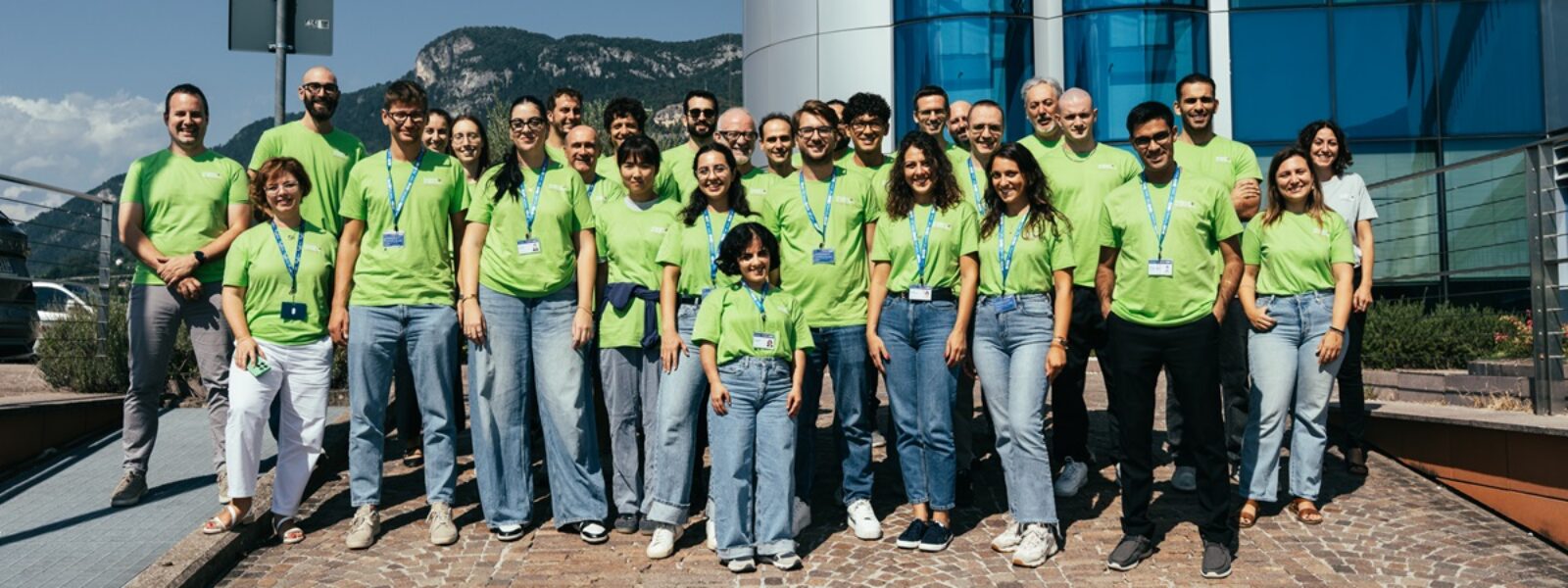
The week-long workshop brought together thirteen students from Italian and international universities and produced three research-based solutions for charting the path to 2050. The winning approach combines the development of technologies for European industry with their application to the challenges of the energy transition.
Friday, September 11 – Three proposals, developed by three working groups, to address one of the major challenges of the energy transition—the path toward “zero emissions,” selected by the organizers: these are the results of Pioneers, FBK’s Summer School, which brought thirteen students from Italian and international universities to Fondazione Bruno Kessler for a week to work side by side with researchers as true research pioneers.
“Pioneers was not a week devoted to telling young men and women what the winning technology of the future will be, but rather to giving them the opportunity to experience how to develop a scientific response to complex problems,” Luigi Crema, Director of the Center for Sustainable Energy, said on the closing day. “They started with materials and laboratory work, worked on batteries, hydrogen and energy systems, and ended up discussing the choices that will shape the energy system of tomorrow. If there is one message we would like each participant to take away, it is that research is not just about finding answers: it is about learning to ask the right questions, bringing together different skill sets and turning knowledge into impact.” ”.
An entire session, the final one, was devoted to discussion and gaming, during which participants took part in a collaborative discussion of solutions to address the challenge of achieving zero emissions by 2050. The “Bet-Zero” group received the final award for a solution based on combining solar and fourth-generation nuclear power, with the aim of integrating these complementary technologies with green hydrogen production. The positive evaluation also took into account the group’s strategic vision for an investment policy based on synergies between research and industry and on identifying appropriate actions in relation to development and implementation timelines.
In the other two scenarios, the “Enfialomeno Nero” group proposed a work and research plan to generate clean energy through hydropower, green hydrogen and biomass, for use in industry and in residential heat pumps. Meanwhile, the “Pardis” group developed a series of incentives to encourage increasingly widespread and informed use of sustainable nuclear energy, with particular attention to critical materials and in combination with other solutions such as hydrogen production.
Throughout the week, the “pioneers” had the opportunity to explore various laboratories at Fondazione Bruno Kessler through a training program and an introduction to research starting from the fundamentals: “We opened the doors of the Sustainable Energy Center’s Cluster Laboratory, where we study advanced materials and where participants were able to see firsthand highly advanced equipment for the synthesis of innovative, nanostructured materials, along with the process of characterizing them from a physicochemical perspective,” explained Gloria Gottardi, Head of FBK’s Cluster Laboratory. “I hope we succeeded in sparking everyone’s curiosity and perhaps even an interest in joining us at Fondazione Bruno Kessler for their thesis work.”
The participants were highly enthusiastic, very motivated and eager to explore the path from research to impact: “I chose to take part in FBK’s Pioneers program because I want to deepen my knowledge of hydrogen, sustainability and the future of energy,” said Antrea Iasonos, a student at the National Technical University of Athens. “I would like to gain more hands-on laboratory experience and, having already done some research on hydrogen, I would like to explore this field further and understand how these technologies can contribute to improving the environment, the energy sector and, more broadly, our future.”