FBK: growth, technological frontier and new infrastructure
From microsystems to artificial intelligence, FBK has translated its research capabilities into technology platforms and concrete solutions for businesses, public administrations, and citizens, strengthening its role as a driver of regional innovation with global reach.
Fondazione Bruno Kessler’s growth trajectory has developed particularly strongly around artificial intelligence and microsystems, areas in which FBK has long been positioned at the forefront of research. Continuous growth in both European collaborative projects and contracts with companies has been made possible by the excellence of its people and a strong capacity to attract talent, which has significantly strengthened the Foundation’s scientific reputation.
This path has enabled FBK to make a fundamental leap forward: evolving from an advanced research center into an institution capable of transforming laboratory results into technological platforms and solutions that can be concretely used by companies, public administrations, and citizens. Alongside the steady growth in collaborative projects and commercial contracts, the Foundation has also made a major qualitative leap thanks to strategic European initiatives. Through these, FBK has been able to attract key funding programs such as the IPCEIs and participation in the AI Factory, marking a turning point in its positioning as a European and international reference in the fields of AI and microsystems.
This growth has triggered a multiplier effect across the ecosystem: a significant increase in the people and talents involved, the emergence of new industrial collaborations, the launch of proof-of-concept programs, and the creation of startups and spin-offs, strengthening FBK’s role as a regional engine of innovation with a global outlook.
From a scientific perspective, FBK was founded around two major areas—microsystems and artificial intelligence—which still represent the scientific core of the Foundation.
In the field of microsystems, FBK has grown steadily in terms of publications and credibility within the national and international scientific communities. For this reason, it is now also a key player in what is known as the second quantum revolution. While public attention is often focused on “quantum computing” and large supercomputers developed by major companies through the use of aggregated qubits, the quantum transformation is already deeply influencing the sensing and communications sectors— areas in which FBK has historically stood out thanks to its expertise in the design and implementation of microsystems for sensing and communication.
In recent years, the Foundation has taken a further step forward by applying quantum science and technology to the development of next-generation sensors and devices. In this context, FBK laboratories created the first qubit in Italy and among the first in Europe. These qubits support the development of extremely sensitive sensors capable of detecting parameters with greater precision, such as humidity in agricultural fields or vibrations in the turbines of hydroelectric power plants.
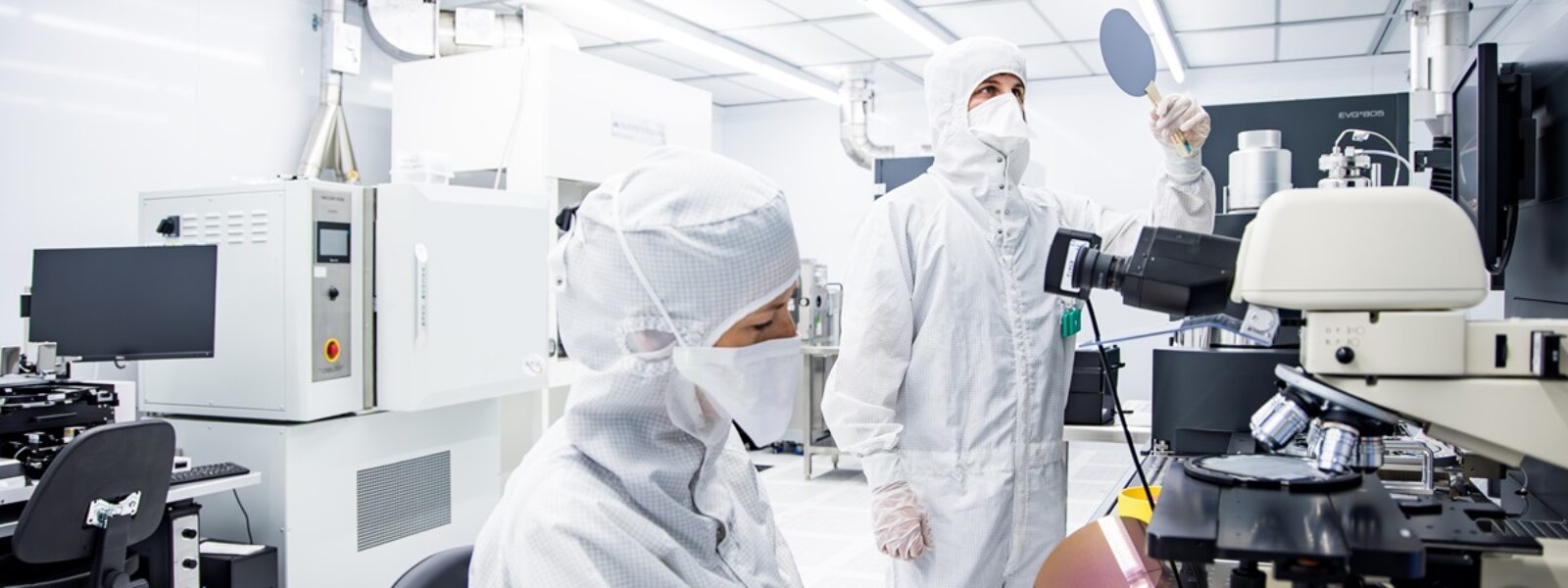
This strategic and long-term vision has enabled FBK to win major structural projects and secure the resources necessary for a further infrastructural leap. Thanks to the funding obtained, the Foundation will be able to build new infrastructure at Povo, with a total investment of about €82 million for new clean rooms. These facilities will expand technological capabilities, enabling activities not only on silicon but also on advanced materials such as silicon carbide and gallium arsenide, further strengthening FBK’s position as a reference center in the production of next-generation miniaturized sensors and devices fully aligned with the frontiers of international research.
Alongside this trajectory, artificial intelligence represents the other strategic pillar of FBK’s identity. Drawing on more than thirty-five years of research, the Foundation promotes integrative, reliable, and distributed AI designed to support people and accompany societal transformation. From frontier research to industrial and public applications, and in service of people, FBK aims to lead the development of safe, verifiable, and impact-oriented AI technologies, helping position Europe as a leader in responsible and sustainable innovation.
FBK also demonstrates a concrete ability to combine scientific excellence with technology transfer. The results achieved in frontier research are rapidly transferred to the production system through collaborations with local and national companies and the development of advanced solutions. Examples include the results obtained in international benchmarks and their translation into industrial applications adopted by local companies and the Italian industrial system, within development paths consistent with major European strategic initiatives such as the IPCEI.
The international recognition of FBK’s research quality is also demonstrated by its recent first-place ranking in the global BOP Benchmark for the 6D Object Pose Estimation Challenge 2024. In this competition, an FBK team surpassed more than fifty international competitors, including groups from major industrial players such as NVIDIA, Meta, and Naver Labs, with a robot capable of interpreting written or spoken commands, understanding the visual scene in front of it, and acting accordingly in an autonomous and reliable way. This represents a clear example of FBK’s ability to compete at the highest scientific and technological levels.
At the same time, FBK is a research partner in IPCEI CIS (Cloud Infrastructure and Services), the first joint European project dedicated to developing a sovereign, interoperable, and multi-provider cloud-to-edge ecosystem aligned with European values. The initiative mobilizes a total of €409 million in support of Italian companies, with the involvement of five national firms, and represents the main instrument of European industrial and digital policy in the cloud and edge computing sector. In this context, FBK contributes to the development of strategic infrastructures and services, strengthening the position of Italy and Europe in the global competition for advanced digital technologies.
Today it is research, but tomorrow it may become a concrete application: in space, in satellites, in security, in infrastructure maintenance, or in advanced manufacturing. The next challenge is technology transfer—this requires policies that connect research results with industry, support the development of a thriving entrepreneurial ecosystem, and provide the necessary funding.