What remains to be discovered about the Higgs boson
he discovery of the Higgs boson marked a historic turning point for particle physics in 2012. But that announcement, far from closing a chapter, opened a new one. Today, the scientific community faces new challenges, aiming to explore crucial aspects such as the rare decay channels of the Higgs boson and the possibility of small deviations from the theoretical model that could point to new physics beyond the Standard Model. To address these questions, much more data is needed than has been collected so far by the Large Hadron Collider (LHC) at CERN in Geneva: more collisions mean more statistics and therefore more precise measurements. In this context, CERN is preparing a major upgrade of the Large Hadron Collider (HL-LHC), which in the coming years will significantly increase the number of particle collisions—up to five to seven times the current rate—allowing the Higgs boson to be studied with unprecedented precision and pushing the boundaries of knowledge even further.
As part of this upgrade, ultra-fast LGAD (Low Gain Avalanche Diode) silicon detectors will be used for the first time. These devices add a fundamental new dimension to event reconstruction: time. This breakthrough, known as 4D tracking, makes it possible to measure not only where a particle passes (the three spatial coordinates), but also when it does so, with an accuracy on the order of a few tens of picoseconds. This enables researchers to distinguish events produced in collisions that occur extremely close together in time, improving event reconstruction under high-luminosity conditions.
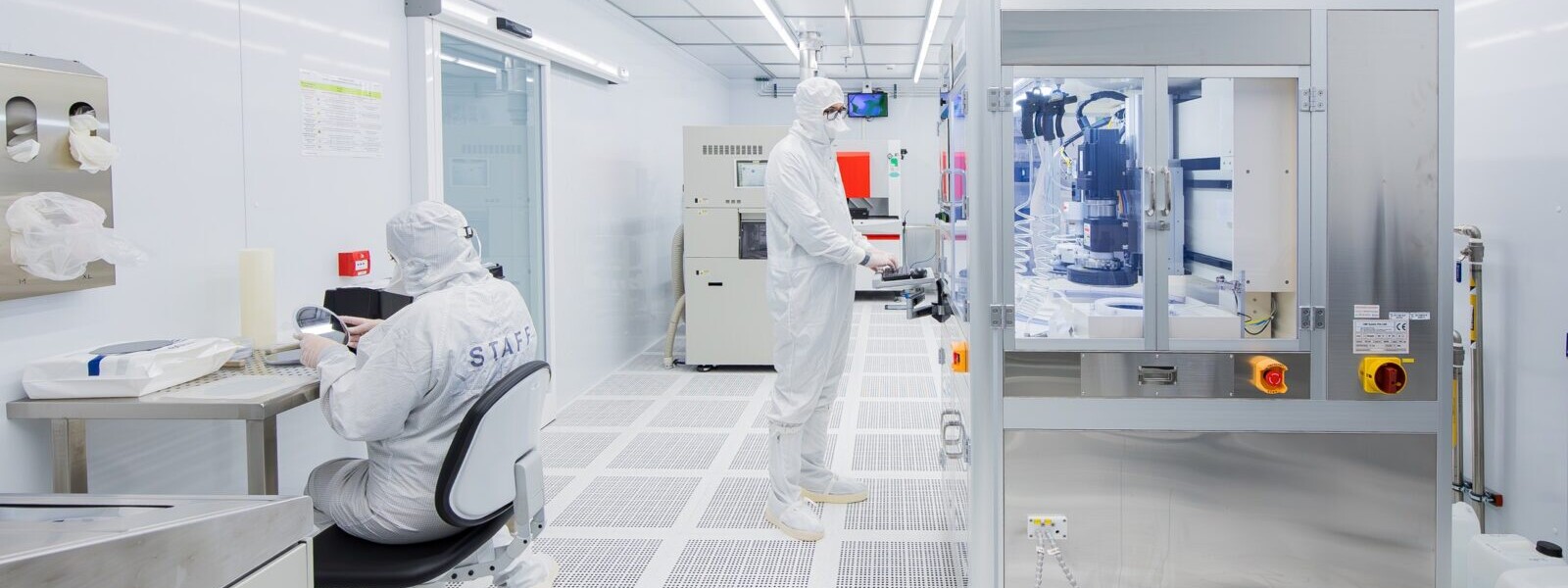
Fondazione Bruno Kessler has played a central role in the technological development, process optimization, and large-scale production of these detectors. The journey began more than ten years ago in FBK’s laboratories and clean rooms and has now resulted in a major supply of sensors for a high-energy physics experiment.