
AIxPA: Digitalization, AI, data management and protection
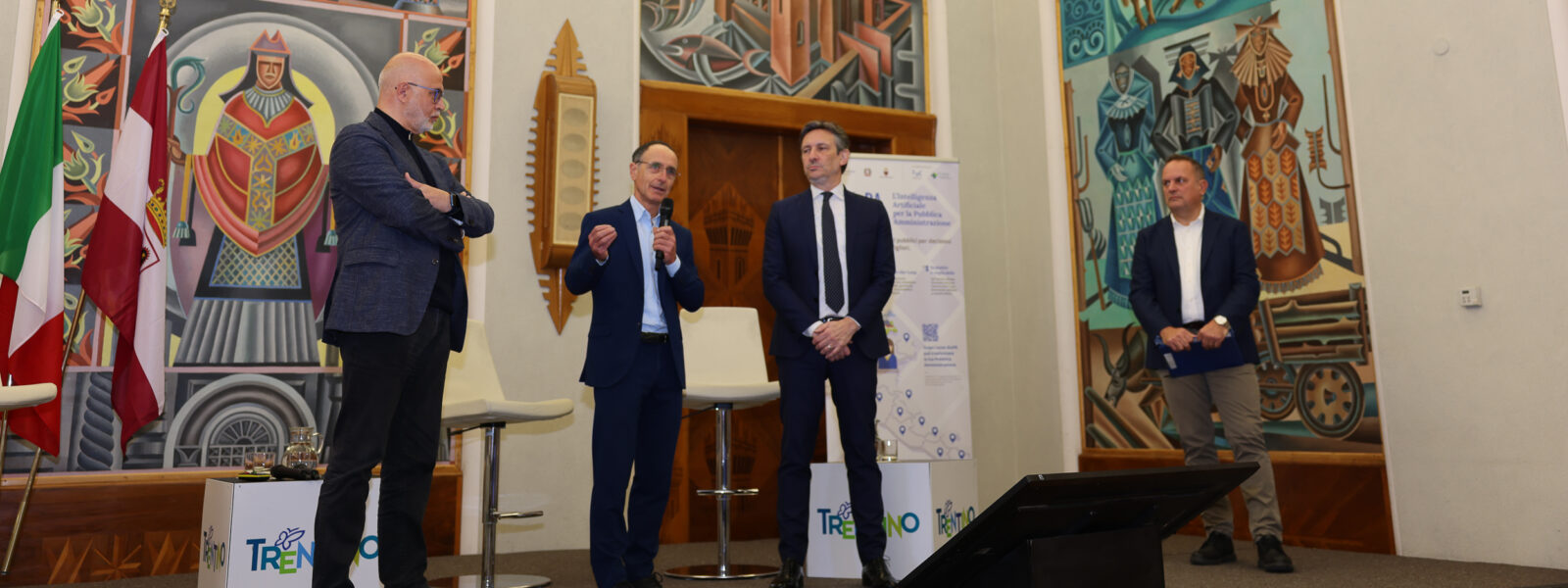
November 6 the initiatives for the digital transition of the region carried out under the Flagship Project were presented — 20 million euros from the PNC for four areas of intervention. In Trentino, another 1,254 projects from the PNRR amount to 40 million euros.
Digitalization, artificial intelligence, data management and protection, and innovative services are key to offering more efficient and timely responses, and to facilitating dialogue among citizens, businesses, and public administration. The focus is also on interoperable platforms and AI systems that support public decision-makers in managing regional policies — from tourism to civil protection — and in delivering public services.
These were among the topics discussed this morning during the meeting dedicated to the conclusion and presentation of the results of the Progetto Bandiera, a program funded with 20 million euros from the National Complementary Plan to the PNRR. The project aims to modernize the information systems of the Trentino public administration, promoting interoperability, cloud migration, the enhancement of public data, and the development of increasingly efficient and accessible digital services.
“The digital challenge for the near future of the Trentino public administration is to break down the monster of bureaucracy, which represents a great cost to society and to businesses,” emphasized Achille Spinelli, Vice President of the Autonomous Province of Trento, in his opening remarks. “With the Flag Project, we are creating a closer, friendlier, and more streamlined system for citizens and businesses. The opportunity offered by the PNRR has enabled us to accelerate the ongoing digitalization process. The goal now is to consolidate the initiatives launched, expand areas of simplification, and progressively test new operating models that are increasingly modern and effective.”
All the key players in the Trentino system contributed to the initiative alongside the provincial structures — from Fondazione Bruno Kessler to Trentino Digitale, as well as HIT, Trentino School of Management, and several private companies that collaborated in the implementation of the interventions. Together with Vice President Spinelli, Andrea Simoni, Secretary General of Fondazione Bruno Kessler, and Kussai Shahin, General Director of Trentino Digitale, opened the session.
Simoni emphasized that the work on the AIxPA artificial intelligence platform marked a significant step forward in how collaboration between institutions and data management is understood: “AIxPA is an ambitious project that brought together institutions and professionals from various departments, Trentino Digitale, and FBK,” he explained. “It’s not just about data integration, but a real engine of change that has innovated processes and brought artificial intelligence into the operational mechanisms of public administration. This, I believe, is its greatest added value.”
Shahin acknowledged the commitment and professionalism of the technical teams involved: “Trentino Digitale worked on implementing software evolution measures and several digital services, some of them particularly complex. It was the result of intense work by many colleagues — often invisible — to whom I extend my sincere thanks for their expertise and dedication.”
Then Luca Rigoni of the Department for Digital Transformation – President of the Council of Ministers’ Office – took the floor, recalling that the PNRR represents the largest public ICT investment in Italian history, with over 6 billion euros allocated to local public administrations and about 70,000 projects funded. He highlighted the Trentino context: “In the province, in addition to the initiatives under the Flag Project, 1,254 projects have been launched, with a total value of 40 million euros — 75% of which are already completed. Moreover, 135 municipalities have migrated to the cloud, and 163 local authorities have joined the National Digital Data Platform (PDND). These results,” Rigoni said, “testify to the region’s strong ability to turn investments into concrete digital innovation.”
Cristiana Pretto and Daniela Ceccato, respectively General Manager of the Digitalization and Networks Strategic Mission Unit and ICT Service and Digital Transformation Manager of the Province, then presented the results achieved in the four areas of the Flag Project. With regard to artificial intelligence, AIxPA has created a platform dedicated to data-driven and predictive public decision-making. Three use cases have already been validated: policy design for work–family balance, monitoring local area fragilities, and managing tourist flows. An AI Toolbox, ethical guidelines, and a co-innovation lab for training and joint experimentation were also developed to support the spread of AI in public administration.
The cloud evolution involved several strategic provincial platforms: a new system for managing research projects and business services, a platform for active labor policies, the cloud-based e-procurement system (serving over 380 entities and 8,000 registered companies), and a new application for family support management, already operational with more than 5,000 submitted applications. In terms of digital services for citizens and businesses, 65 new online services have been created, and the Catalogue of Provincial Services — now covering 100% of Trentino’s public services — has been completed. The migration of 38 thematic websites to the new provincial portal, active since June, has also been finalized. In addition, a chatbot has been developed to make access to services easier, along with a new personal area within the Citizen’s Room, which integrates digital services and applications in one place, allowing users to track and verify progress directly. Finally, through the Territorial Competence Node (NTC), training and mentoring programs were offered to over 700 public operators, fostering a community of practice around digital skills. Three events were dedicated to software reuse, change management activities on AI were launched, data governance domains were analyzed, and new dashboards for exploring public data were designed.
FBK researcher Andrea Nicolini then provided a detailed overview of the work that led to the creation of the AIxPA platform, an AI ecosystem tailored to public administration. Thanks to predictive models and digital twins, the platform transforms complex data into clear, actionable information, supporting faster, more informed, and secure decisions — all while ensuring full respect for data sovereignty and public governance.
Following this, Romano Stanchina and Roberto Pizzicannella of the Department of Crafts, Commerce, Promotion, Sport and Tourism of the Province shifted the focus to applications in the tourism sector, where a monitoring platform was developed. Based on scenario analysis, it enables policymakers to read and fully assess tourism data for specific territories, helping them identify the most appropriate policies and actions for effective management.
Kussai Shahin then discussed “Artificial Intelligence for Public Administration: From Projects to Services.” He emphasized the need to foster innovation while managing the complexities of digital transformation, underlining Trentino Digitale’s role in supporting public administration in designing and implementing AI solutions aimed at optimizing public services and making them increasingly innovative and responsive to citizens’ and businesses’ needs.
The event concluded with a panel discussion, moderated by Andrea Nicolini, on the opportunities and challenges of artificial intelligence in public administration, with contributions from Paolo Traverso (Director of Strategic Planning, FBK), Luca Rigoni, Silvia Marchesi (Director of the Simple Mission Unit for Artificial Intelligence of the Province), Daniela Ceccato, Kussai Shahin, Romano Stanchina, and Fabio Massimi (Agency for Digital Italy).
Interview with Vice President Achille Spinelli
Souurce: PAT Press Office